
Lifestyle & Success

5 Practical Tips For Team Leaders

COVID-19 has ruined the transparent and universally recognized system that has been working out perfectly for so many years. The typical 8-hour working day is no longer an option for all the office workers around the globe. Teams and their leaders had to go to the new routine overnight. Millions of the employees have lost their jobs; even more, they are left in the comfort of their homes unsupervised.

The U-word scares a lot of team leaders and makes them implement bizarre restrictions they would have never imposed on office people. For instance, the Wall Street Journal tells its employees to let their managers know when they are having a break, interviewing someone or having a meeting. It’s indeed hard sometimes to organize a remote team, but you might want to avoid restrictions that scream: “I don’t trust you!” which are not really motivating.

We have piled up tips that would help any leader keep their team motivated without having to micro-manage.

Study The Facts

Although almost every boss wants to keep his/her team in sight, it’s been proved by numerous studies that remote workers are more productive than office dwellers. Surprised?

A Stanford professor Nicholas Bloom conducted research including 16,000 workers of Ctrip, China’s largest travel agency. Every six months, he divided 500 employees into two teams: 250 employees worked in the office, 250 worked from home. The two-year study revealed that remote workers improved their performance by 13%. That’s almost one additional day a week, says Nicholas Bloom in his 2017 TEDx talk. (Highly recommended to anyone managing remote teams!)

According to Bloom, there are two main reasons for that. Firstly, remote employees work their full shifts. They don’t have to commute, so they never arrive late or leave earlier. Secondly, the offices are far more distracting than we think, and a lot of employees report they can concentrate better at home.

Photo by nappy from Pexels

Help Your Team Cope With Stress

Although the studies have shown that remote workers are not that bad, it’s important to remember that your employees didn’t choose to work from home voluntarily during the pandemic of 2020. They were required and some were even forced to do this by the scary circumstances they can’t control. News about people dying, worrying about their children or older relatives, almost no face-to-face interaction can lead to anxiety.

“The change to almost complete remote work around the world has initiated unforeseen mental health challenges associated with work for many employees, which employers have a significant role in alleviating,” says Silja Voolma, Ph.D., applied behavioral scientist and CEO of Behavioral Design Global.

However, you can help your team make its work in these conditions less stressful. Dr. Voolma recommends setting impactful goals that make a difference. Do not load your team with meaningless jobs; explain to its members why their contribution is valuable, and identify the tasks that need to be completed.

A US clinical psychologist Frederick Herzberg believed that most of the employees are motivated mainly by intrinsic rewards, like interesting and challenging tasks or opportunities to achieve and grow into greater responsibility. Learn what are your employees’ internal generators and activate them.

Organize The Workspace Remotely

Having a normal, distraction-free working environment at home is as important for the team as keeping its spirits up. The majority of your employees do not have proper home offices. Give your colleagues a hand organizing their workspace.

Colliers International, a company in real estate services and investment management, recommends creating a plan to support and supply employees in need. Consider furniture, seating, lighting, noise levels and internet bandwidth.

Ship over anything your team may need to be more productive. For instance, Ukrainian software company MacPaw brought office chairs to its employees’ homes; and American dating startup Hily provided its developers with double monitors.

Establish A Clear Schedule

A new survey by the Airtasker, an online platform that connects consumers with gig workers, suggests that a third of remote workers struggle to find a proper work-life balance. The absence of clear working day boundaries makes the whole day routine go down the drain and messes with a person’s basic needs. For instance, lack of sleep can lead to drastic things: it costs the US economy $411 billion a year and over 1 million lost workdays.

That’s why you may want to establish clear working hours and start your day with a regular morning meeting where everyone on the team will share their plans for the day. Nicole Bendaly, the President of K&Co, a company that improves team and leadership performance, says such morning check-ins will help to focus on key priorities and maintain a sense of community.

Over-communicate

In times when healthy face-to-face communication is out of reach, talk to your team more. Build connections between different departments; let them know what the whole company is up to. Praise employees for reaching goals in team chats to lift their spirits. Take one-on-one meetings with your employees more seriously than ever, ask questions about what affects their productivity and mental health, and react.

A famous American management consultant and educator Peter F. Drucker believed that the most important thing in communication is hearing what isn’t said. 85% of what people take away from the conversation is based on body language and facial expressions. With that being said, consider conducting all of the meetings via video chats. It will help to capture moods and emotions that aren’t available in writing or even in simple phone talks. 

Tiina Saar-Veelmaa, psychologist and founder of happyme.ee, thinks that the survivors will be businesses whose cultures are built on honesty, inclusion, transparency and flexibility. Build trust and unity, and remember that we are all in this together.


Lifestyle & Success

Always busy running errands even during the quarantine?  Leading such a bustling lifestyle in the constantly changing and unpredictable world can be exhausting. Thus, chances are you’re familiar with the dampening sensation of laziness. It may occur suddenly or when you expect it; it may concern a task that needs to be done or an activity that seems to be desirable, like making a good meal. In this article, we will look behind the facade of a phenomenon called “laziness” and try to understand what is hidden behind it and why it prevents you from moving in a vigorous march toward your goals.

None of us has ever experienced living during the global pandemic of a new virus. Constantly staying in and not being able to visit your family or places is a huge load on the psyche. The brain processes it, and it may not have a resource for new knowledge.

So even now, how to do your best and actually focus on work? Let’s find out.

What Is Laziness: a Bad Habit, Lack Of Discipline Or…?

There are different points of view on this matter. You surely are familiar with the negative one, where the laziness is seen as a manifestation of weakness. However, there is a positive attitude toward indolence. For example, in positive psychotherapy, developed by Nossrat Peseschkian, it’s “the ability not to do too much” and is perceived as a totally normal state of the human body and mind. 

Basically, what we call laziness, is a signal coming from our psyche, carrying a message that we’re not willing to perform a certain activity. There are different causes of it, however. Thus, our task is to “unravel” the message of the idleness and take appropriate measures.

Photo by Ekaterina Bolovtsova from Pexels

The Root Cause

According to modern psychology, there’s only one reason for laziness – the mismatch of our intentions, goals, objectives, aspirations, to our true needs.  When our behavior is consistent with physical AND mental necessities, we don’t have any problems finishing that report or reading those emails: there’s no laziness, boredom, procrastination or any other forms of detachment and attempts to postpone the inevitable. We simply do what we have in mind. It is really easy. There is a well-known saying that proves it: “The most motivated person is the one who wants to use the bathroom.” We must agree that it is difficult to imagine someone like that being lazy.

The Intrapersonal Conflict

According to Noah Chomsky’s doctrine on dominance, for every person, only one need is relevant at a time, and all human behavior is subordinated to its satisfaction. If during this time a person sets an objective that is not consistent with the urgent need, the “center of dominance” in the cerebral cortex slows down the implementation of the task. Usually, in the form of laziness. In modern psychology, such a situation is called an intrapersonal conflict, the incompatibility of “wants” and  “needs.” Hence, laziness is a form of resistance of your body, which signals that you need to stop and rethink your priorities.

Overcoming Laziness Through Working With Your Needs

Self-reflection is always difficult and purely individual. However, a number of general recommendations will help to resolve the intrapersonal conflict and free up useful energy for reaching your goals.

Step 1: Listen to yourself

Often taking this step is enough to reduce stress and start catching up on with your daily plan.  Instead of updating your social media feed, try to take a short pause and ask yourself the question: “What do I need now?”
It can be difficult to answer the question, and there’s no need to rush. It is important to develop the habit of being attentive to your inner world, and sooner or later you will be able to reflect on your true needs. Notably, the purpose of asking this question is to take control of your laziness, so you will consciously decide when to work and when to rest.

Step 2: Acceptance

Instead of self-flagellation or attempts to “force” yourself, try to listen to your body and respond correctly. When you realize your true actual need, you will have to make a choice: satisfy or ignore it. It is important to decide responsibly: you must fully consider the consequences of your choice. Remember the following:

  • According to the 2019 study of The American Institute of Stress, disregarding your needs can lead to stress, anxiety and fatigue. 
  • By immediately making a choice in favor of satisfying your need, however, you might encounter a number of other consequences (like letting down your colleagues by not doing what you were asked for.) 

In general, the practice of conscious and responsible choice will save you not only from laziness but also from many other problems that give rise to intrapersonal conflicts.

Step 3: Applying adequate techniques

After you understand your needs and make a responsible choice, deal with it. To put it simply, three types of laziness can be distinguished: “I don’t want,” “I can’t” and “I don’t believe I can.” 

The “I don’t want” type occurs when a task doesn’t really look attractive to us (it is uninteresting for our Inner Child, we have no sincere desire to do this.) This option is frequent because nowadays our lifestyle is full of responsibilities we must commit to.

The “I can’t” arises when we don’t have enough physical or mental resources for doing something (for example, we are tired, hungry or too excited.) Such laziness comes for telling us there is no “fuel” for this activity now.  It’s like when you found a course you really want to take, but after a busy day, you don’t have the right amount of energy to concentrate on new information.
The “I don’t believe I can” laziness happens when we set incredibly high standards for ourselves (to do something without mistakes or better than everyone.) And then the so-called “perfectionist paralysis” arises, because the requirements are so impossible to accomplish that it’s easier to do nothing at all than to start and experience failure.

For the option “I don’t want”: 

  • Delegate the task to someone else; 
  • Increase its attractiveness (e.g. reward yourself for the accomplishment); 
  • Switch to an alternative (select an activity from your to-do list that you want to start right now, like “I don’t want to write an article, but I’m ready to do the cleaning”); 
  • Find a meaning (justify the usefulness of this piece of work and how it will allow you to be proud of yourself, look attractive in the eyes of others, etc.)

For the option “I can’t”: 

  • Find out what kind of resource are you currently lacking (strength, clarity of mind, patience, etc.) and how it can be replenished (right now you don’t feel like reading this email but after a cup of coffee, you’ll be ready); 
  • Postpone your deadline, take some rest and get down to work later.

For the option “I don’t believe I can’t”: 

  • Rethink the desired result – make it down-to-earth and realistic; 
  • Solve the problem “in pieces”. Instead of aiming to finish a paper in a week, offer yourself to write an introduction today, the first chapter – tomorrow, and so on. 
Photo by Prateek Katyal from Pexels

And a Universal Tip

  • The Five-Second Rule

Whenever you feel unsure about completing a task, count from 5 to 1. According to Mel Robbins, such a tool will help you concentrate on a certain goal and get rid of anxiety, hesitation or negative thoughts.

Nowadays, social media make us think that every person during quarantine needs to get up at 5:00 a.m., then do yoga, prepare a healthy breakfast and devote the rest of the day to watching webinars and reading books. But that’s just social media. What do YOU want? In the end, laziness is not your enemy, but a great opportunity to actually listen to your desires. Maybe you don’t really need that second job you’ve been thinking about. Maybe it’s time to start pursuing your passion, even when no one understands it or if it sounds crazy. By doing what you truly love, you might eventually boost your productivity without reading a million advice and trying too hard. 

Lifestyle & Success


“We speak different languages!” – that’s a phrase you’ve probably said to your partner or family members at least once in a lifetime. Sometimes two people simply cannot find a common ground, and their dialogues are reminiscent of a blind talking with a deaf. Without mutual understanding, people become more distant from each other, and that leads to frequent arguments, or worse – total detachment

Nowadays, due to the quarantine, we stay side by side with our loved ones around the clock. And this is not always easy. However, to keep your relationships alive, be it with a parent, or a romantic partner, you need to express your feelings. Even if you feel your thoughts are too tangled and too complicated to share. Even if you’re offended, disappointed or angry. Even when there’s an unresolved conflict you don’t want to go back to. 

Thus, in order to make your relationships with a close person thrive, follow these simple steps to bring the deepest thought into conversation. 

A “soft start”

A psychologist John Gottman found that the conversation most often ends with the same emotion it begins. If you rush into saying harsh words to your loved one – you actually leave them even more lonely.

Gottman offers a crucial concept: a soft start to the conversation. It means avoiding criticism, derogatory remarks, sarcasm, accusations, generalizations (you never … you always …) and the transition to the individual. Also, a soft start, in particular, is talking about yourself and your feelings. For example, instead of saying “It’s nonsense”,  answer “No, I don’t agree.”

Support yourself

In nonviolent communication practice, there is an algorithm for circumventing your “difficult” feelings. The basis of this algorithm is self-empathy, meaning recognizing and naming your feelings, unmet needs and self-compassion. Magically, when we say, “I’m in grief now,” our pain becomes bearable. Check it out for yourself!

Imagine that your beloved friend is in a critical situation. You would try to understand and sympathize with her/him, right? That’s exactly what you need to do for youreself, especially when you feel low.

“So, what exactly needs to be done?”

  • Become aware of your current body sensations (for example, chest tightness);
  • Ask yourself what you’re feeling right now;
  • Decide what is important for you (in life AND in relationships) and identify which your needs might be unsatisfied;
  • Think about the requests you have to yourself or others.

Let’s say, you’re telling an exciting story to your spouse, and he/she is not actively paying attention to you and instead is scrolling his social medium’s feed. 

What might be going on in your body? Rapid breathing or tension-type headache. 

What do you feel? Irritation, anger. 

What need is not met now? Having your spouse’s attention.

What is important to you? Your husband’s/ wife’s involvement and response. 

What request do you have for the partner? Looking at you when you say something.

Such self-reflection allows you to express your feelings in a more gentle way. Also, when we just allow ourselves to cool for a few seconds, the tension noticeably weakens. 


Remember the two main goals

What are the goals of a frank conversation about relationships? Psychologists do not recommend doing the following:

  • splash out the accumulated irritation;
  • hurt a partner;
  • prove yourself.

Then, what should be considered the right purpose of a conversation? Here are the two main goals, according to Gottman:

  • tell how you perceive and feel the current situation;
  • understand how your partner feels and perceives it.

Actually, there’s even a third goal, which is not always achievable, though. It is to agree on how to prevent such situations in the future. How to deal with contradictions in views, habits or desires. That is, come to a decision.

Alas, not all life situations can be predicted. Therefore, the third goal of the conversation, although attractive, is optional. If two main goals have been achieved, such a conversation will be healing.


Do not forget a simple wisdom: “Communication is the key.” Talk about your feelings! And listen, listen to yourself and others. This is the best way to get closer to people and the best way to understand what’s happening to you or your loved ones. 

Lifestyle & Success

The worldwide pandemic is definitely not bringing a positive impact, and a lot of people are bored staying isolated or #stuckathome. But it’s not a reason to lay on a couch all day long, being upset there’s nothing to do. The quarantine can be turned into something you always wanted – a time of self-isolation as a time for self-evaluation. What is that that you never had time for? And now when you LITERALLY can’t come up with such an excuse as no time, you can spend the quarantine differently. Like fun. Or in a new way.

1. Have a Skype party with friends

This social gathering format came from China. It’s easy to arrange: make a group call on Skype, turn on your favorite music and dance in front of your smartphones or laptops. The main bonus is that when you get tired of dancing, you don’t have to spend money on a taxi. And yes, and you can come to the party even in pajamas.



2. Visit online museum

Fortunately, in the era of the Internet, you can visit the greatest museums in the world without leaving your home. Here are just a few options:

The Louvre Museum offers a 360-degree panorama, so you can take a close look at the rare artifacts around. If you click on the exhibits, you can get additional information about their history.

On the website of The National Gallery of Art, one of the best collections of Italian Renaissance paintings in the world, you can access works of Dutch and Spanish Baroque.

Google Arts & Culture works with more than 60 museums and galleries from around the world. Using Google Street View technology, a visitor can explore the collections of, for example, the White House in the US, the Museum of Islamic Art in Qatar and even the São Paulo Museum of Street Art in Brazil.

3. Read a book

Reading is a peculiar form of relaxation, which helps to deal with stress and bad mood. You probably have planned to read some books that your friends recommended but haven’t been able to fit it in your schedule before. Well, now it’s the perfect chance to catch up on them! In case if you run out of ideas on what to read, enjoy these top books on self-improvement:

    • Whatcha Gonna Do with That Duck? And Other Provocations by Seth Godin;
    • Fooled by Randomness: The Hidden Role of Chance in Life and in the Markets by Nassim Nicholas Taleb;
    • The 48 Laws of Power by Robert Greene;
    • The Attention Revolution: Unlocking the Power of the Focused Mind by Alan Wallace;
    • Mindsight: The New Science of Personal Transformation by Daniel J. Siegel;
    • Feeling Good: The New Mood Therapy by David D. Burns.

4. “Visit” opera/theater

The Vienna Opera (like other Austrian theaters) canceled all its performances until April 2. Instead, it will broadcast daily recordings of opera and ballet performances through the platform. Streams will begin at 5:00 CET and will remain available for 24 hours.

Moreover, the Bavarian State Opera will make available six live broadcasts of the 2019/2020 season, including the Snow Queen Hans Abrahamsen, Judith Bela Bartok directed by Katie Mitchell, as well as the world premiere of a video art project by Marina Abramovich The Seven Deaths of Maria Callas.

If you spend a lot of time on Instagram, diversify your feed and subscribe to Theather without Theather. In its daily posts, you can see artists reading poetry, performing drama pieces, dancing, singing and many more!

5. Workout

Don’t rush into buying a treadmill. There are tons of free tutorials on Youtube from relaxing yoga to exhausting Tabata training. Lufian recommends the following channels for at-home workouts:

  • Blogilates;
  • The Fitness Marshall;
  • HASfit;
  • Leslie Sansone’s Walk at Home;
  • Tone It Up;
  • jessicasmithtv;
  • Fitness Blender.

6. Learn a foreign language

Quarantine is not a hindrance to exploring a different language. It is enough to register for free at Duolingo, subscribe to native speakers on Youtube or watch the series in the original with subtitles. If you seek a different language learning experience, we suggest these platforms:

Live Mocha (interaction with native speakers);

LingQ.com (the basics);

Lang 8 (native speakers correcting your writing);

Papora (grammar and vocabulary);

Memrise (flashcards).

7. Start journaling

It’s the best time to reflect on the past, define your goals for the rest of the year or simply put on paper what are you currently thinking about. According to a book by a social psychologist, James Pennebaker, expressive writing improves health, alleviates emotional pain and boosts productivity.

What things bring joy to your life? Where do you see yourself in ten years? What decisions can lead you to make your biggest dream come true? These are some questions you can ask yourself and then write down everything that is on your mind. Don’t worry about picking the right words! Not everything you write down has to be beautiful or poetic. If you feel like it, express your emotions through drawing or making sketches in your notebook.

8. Watch a movie together

Wanted to watch a movie with friends but self-isolation has interfered with your plans? Not a problem! Netflix Party, an extension for the Chrome browser, allows Netflix users to chat and watch movies together. We made a list of the most intriguing and exciting documentaries available on the platform:

• The Great Hack;

• The Unknown Known;

• The Vietnam War;

• The Mind, Explained;

• Sex, Explained;

• Oceans.

9. Take a course

Leading universities and companies in the world, including the University of London, Yale, Johns Hopkins University, IBM, Google, Intel, have opened access to 3800 courses and 400 specializations at Coursera. They will be available until July 31. You can also take a look at these online education platforms to gain a new skill and expand your knowledge at a topic of your choice for free:

Khan Academy

  • Open Culture;
  • Udemy;
  • Academic Earth;
  • edX.


10. Help others

During the times of the virus outbreak, there are millions of people who suffer due to various reasons, be it the pandemic, hunger or lack of housing. Thanks to these websites and applications, you can offer a hand by making donations:

• ShareTheMeal (a smartphone app to fight global hunger through the United Nations World Food Programme);

• Charity Miles (donate by achieving your fitness goals);

• Give 2 Charity (converts the time you spend using your phone into donations).

Lifestyle & Success

1. Start with a friendly phrase

It is important to soften the answer so that at first glance it seems that you agree with the person. In a further speech, it will be clear that this is not so, but the opponent will already be located toward you.

2. Take your time

You probably heard that haste makes waste. Well, this proverb indeed comes from people’s experiences. It’s better to take your time before you give a hasty answer based on emotions. You don’t want to regret the words you can’t take back.

3. Answer the question you want to hear

Almost all the politicians’ speeches are based on this point when they speak about everything and nothing at the same time. If you were asked a tricky question that you want to avoid, slightly reformulate it in your mind so it becomes more comfortable to answer.

4. Admit mistakes without betraying a team

Of course, if there is a flaw in your work, you can refer it to the team (if there is one,) but this will be the ugliest option which most likely will not go unnoticed. Admit that you made a mistake, but you are willing to work on it. Confess what lessons you learned. People always appreciated and will appreciate honesty and hard work.

5. Try to anticipate criticism

The most important thing is in the end. If you have to speak in public, think ahead of time what questions can be criticized. Write down the answers and practice them. It will also help you feel more confident.

Lifestyle & Success

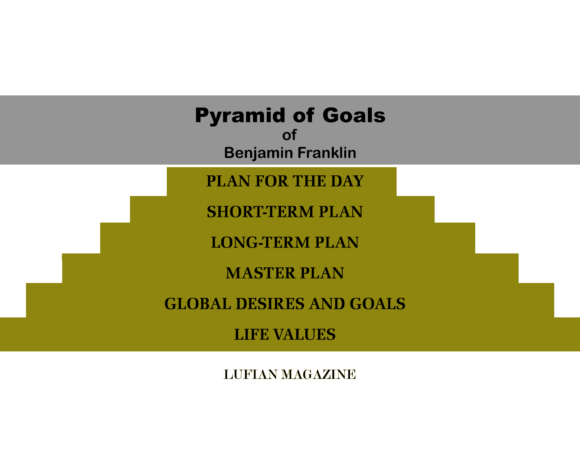
Life values

They are the foundation of the entire pyramid. They predetermine your chosen path, and therefore the setting of goals. The main thing is to ask yourself “What is the most important thing for me in life?”

Examples of values: seeking wealth, helping others, family, fame or creating something new.

Global desires and goals

A new challenge is the definition of global goals. Moreover, it can be far from one goal.

An example of a global goal: to create a corporation, reviews, offspring, to reveal your talent, etc.

Master plan

This is the third block based on a global goal. It is being created for 5–10 years in advance. It is a detailed step-by-step instruction.

Example: go to courses, create a portfolio, make the necessary connections.

Long-term plan

It is calculated for 1–5 years and is a detailed analysis of one of the points of the master plan.

Example: you are going to take courses. Where to? When? How much money is needed? How long?

Short-term plan

The period from a month to a year. This stage was created in order to concretize the tasks.

Example: preparing for an exam, acquiring the equipment necessary for the operation.

Plan for the day

This is the very top of the pyramid. The idea is to break down the steps of the short-term plan into smaller assignments that you can complete in one day.

Example: go to a hardware store and buy a microphone, learn a chapter on economics.

Lifestyle & Success

Every year for the Wolrd Book Day, Branson compiles a list of books he thinks all should read during their lifetime. The list consists of children’s books, fiction and non-fiction literature. Here are the top five books that the billionaire highly recommends to everyone who wants to grow and expand the worldview:

  1. Adventures of Huckleberry Finn” by Mark Twain;
  2. The Hitchhiker’s Guide to the Galaxy” by Douglas Adams;
  3. Black Box Thinking: The Surprising Truth About Success” by Matthew Syed;
  4. Cosmos: A Personal Voyage” by Carl Sagan;
  5. Abundance: The Future Is Better Than You Think” by Peter Diamandis and Steven Kotler.

Warren Buffett in his interviews often mentions his love for literature. However, he reads not to get an author’s opinion but to learn new facts. So journalists periodically ask for his personal recommendations. The following are the five books that Buffett loves the most:

  1. “The Intelligent Investor” by Benjamin Graham;
  2. Common Stocks and Uncommon Profits” by Philip Fisher;
  3. Jack Welch and the G.E. Way: Management Insights and Leadership Secrets of the Legendary CEO”  by Robert Slater;
  4. Business Adventures: Twelve Classic Tales from the World of Wall Street” by John Brooks;
  5. Nuclear Terrorism: The Ultimate Preventable Catastrophe” by Graham T. Allison.

The journalist Brad Stone in his book “The Everything Store: Jeff Bezos and the Age of Amazon” listed the literature that has influenced Bezos and his success. Below see the five books out of many others that the founder of Amazon encourages to read his colleagues and employees:

  1. The Remains of the Day” by Kazuo Ishiguro;
  2. Sam Walton: Made in America” by Sam Walton;
  3. Built to Last: Successful Habits of Visionary Companies” by James C. Collins and Jerry I. Porras;
  4. Data-Driven Marketing: The 15 Metrics Everyone in Marketing Should Know” by Mark Jeffery;
  5. The Black Swan” by Nassim Nicholas Taleb.

In 2015 Mark Zuckerberg created a Facebook page where every two weeks during the year he tried to write about different interesting books. At the end of the year, he collected a decent list of literature that is worth attention. Here are five of them:

  1. The Beginning of Infinity” by David Deutsch;
  2. World Order” by Henry Kissinger;
  3. The Rational Optimist: How Prosperity Evolves” by Matt Ridley;
  4. Enlightenment Now” by Steven Pinker;
  5. Orwell’s Revenge” by Peter W. Huber.

When people ask Elon Musk how did he learn to build the rockets, he always answers, “I read books.” Even though Musk never named his favorite literature, he still loves discussing them.

  1. The Lord of the Rings” by John R. R. Tolkien;
  2. Benjamin Franklin: An American Life” by Walter Isaacson;
  3. Superintelligence: Paths, Dangers, Strategies” by Nick Bostrom;
  4. “The Moon Is a Harsh Mistress” by Robert A. Heinlein;
  5. Our Final Invention” by James Barrat.
Lifestyle & Success
  • Tell me about yourself. What are your career goals for the next 1/5/10 years?

Your task is to describe your experience in a few words, dwell in more detail on the achievements that you have at the moment, and also briefly share your goals for the future.

Tell them what brought you to the interview, what requirements you meet and what efforts you have made for this. Show them how you are guided in your actions. Let the recruiter know how your position is related to your career prospects. Create the basis for moving a regular interview into an effective dialogue format.

  • Why did you choose this position?

Most employers look to hire individuals with critical thinking. It’s in your interest to prepare a good answer here. Make sure they see your enthusiasm and desire to work for their organization.

  • Why did you leave your previous job?

Be positive no matter the circumstances. You should not mention any serious issues with your previous employer or say anything bad about the company and colleagues. Talk about your interest in the new potentials, opportunities and ways to express yourself, etc.

  • What is your work experience and why should we work with you?

In your answer, focus on the responsibilities of the position you are applying for. You should understand how they relate to your skills. If you are lacking some experience, your awareness will play into your hands.

  • How do you think your colleagues and managers would describe you?

If you are struggling to answer instantly, talk to your ex-colleagues or professionals that you know and prepare one or two quotes.

  • What do you know about our company? Why do you want to work for us? Why are you applying for this position?

Make sure you do your research about the organization before the interview. Find as many details about its history as possible. How has it been growing? What are its current struggles? Who are its partners? Who are the competitors? Explain how you support the company’s mission and try to connect your answer with your skills and goals.

  • What salary do you expect?

Honestly, it’s a provocative question and a complicated game that you are likely to lose if you answer first. Consider the possible experience that you can get as the main reward. Or ask about the salary range of someone with your education/experience/skillset in that position. You can also say that it depends on the details of the job. Ask if it is possible to discuss this question at a later stage of the interview so that you fully understand your responsibilities.

  • Give some examples of your ability to improvise.

Companies look for innovative thinkers who don’t need to be babysat. They want professionals with creative thinking who work independently and can solve any assigned tasks in almost any environment. Prepare the answer to this question in advance. 

  • Tell me about how you managed to help the team focus on the goal and lead to success.

You are a team player, right? Be prepared to share stories about how you supported colleagues at difficult times and promoted their professional growth.

  • Do you apply for other vacancies?

Be honest, but don’t spend a lot of time answering. Focus on this interview and what you can do for this organization.

  • Have you ever been fired?

And again, be honest. But at the same time, be brief and avoid negative statements about yourself, about other people or about any organization.

  • What are your strengths? Tell me about how, with their help, you managed to smooth out the difference between failure and success?

Some good examples: the ability to prioritize, the ability to work under stressful conditions, leadership skills, reporting skills, etc. The main thing is to sound truthful.

  • Describe the person with whom you would refuse to work together.

Do not be trivial. This may be a lack of loyalty of a colleague to the organization and employees, his criminal behavior, manifestations of cruelty and violence. Minor objections will not play into your hands. Focus on discussing your ability to work well with almost everyone.

  • Have you ever thought about how you can improve working conditions in the organization?

They want to see that you are capable of:

1) be responsible enough to think about these kinds of improvements;

2) think creatively and challenge existing norms;

3) use emotional intelligence, working on improvements, including for other employees;

4) take into account the risks of changes.

  • Have you had any problems with your trainer/supervisor?

This is a trap, and you will fall into it if you start criticizing someone. Say that you did not have any problems or tell a short story about how you constructively worked to solve the problem and as a result strengthened your relationship.

  • What motivates you to give all your best? Or: What do you expect from your employer?

This is personal – be precise and honest. Examples include challenges, conditions for success, recognition, help to others. In the case of expectations, you can say about clear directions, thanks to which you can strive for better results. Add whatever you think is appropriate.

  • What are your weaknesses? Tell us about things that you are not good at.

Focus on professional growth. When discussing weaknesses, always say “but.” For example: “In the past, I made too many commitments, and it put a lot of pressure on me, but I overcame it because over time my skills got better.”

  • Describe the case when you had to analyze several options for the development of events and make the right, informed decision.

This question is being asked to discover strategic thinking abilities in you. Tell a story about a difficult situation, give detailed information about the pros and cons of the situation, about the sources of information obtained, about the information collected in general and about the conclusions made in order to come to a certain conclusion.

  • What helps you to remain a collected person? How do you put your affairs in order?

Planning requires certain skills. Talk about how you prioritize, for example, while working, what methods and tools you use. Tell them how your attention to detail at some point in your life led you to success.

  • Do you have any questions?

Prepare about 5 questions to gather the information you need to make an informed decision. These questions should allow you to better understand the position, as well as warm-up your interest in working in the company.

Lifestyle & Success
Screen Shot 2019 11 14 at 2.53.08 PM

The Hacksaw Ridge

Combat medic Desmond Doss, played by Andrew Garfield in this true story from the second world war. Doss is crazy enough not to carry a weapon. “I never claimed to be sane!” grins Doss. Actually, that is exactly what he claimed to be. Doss was a patriot who had volunteered for military service. Violent abuse in childhood made him become a doctor in the field of battle. No gun...

Screen Shot 2019 11 14 at 2.59.47 PM

The Intouchables

The Intouchables tells the true story of a wealthy, physically disabled risk-taker whose world turned upside down after few life-changing events. Suddenly, he hires a young, good-humored, black Muslim ex-con as his caretaker. The union of these two extremely different individuals can inspire everyone to fire one’s life up with love, friendship and appreciation.

Screen Shot 2019 11 14 at 3.01.18 PM

12 Years a Slave

Based on the 19th-century memoir of Solomon Northup, 12 Years a Slave follows the tribulations of an educated carpenter, musician and family man from New York state who, in 1841, was kidnapped and sold into slavery in the south – a shockingly common phenomenon. Stripped of his past, he tries to identify himself and even (in the eyes of the law) his humanity.

Screen Shot 2019 11 14 at 3.03.02 PM

The Revenant

Inspired by true events, The Revenant demonstrates an epic adventure of survival and the extraordinary power of the human spirit. In an expedition of the uncharted American wilderness, legendary explorer Hugh Glass (Leonardo DiCaprio) is brutally attacked by a bear and left for dead by members of his own hunting team. Guided by sheer will and the love of his family, Glass must navigate a vicious winter in a relentless pursuit to live and find redemption.

Screen Shot 2019 11 14 at 3.06.02 PM

The Southpaw

Billy Hope (Jake Gyllenhaal), the reigning Boxing Champion, seemingly has it all: a successful career, a beautiful and loving wife, an adorable daughter and a lavish lifestyle. When tragedy strikes and his friend leaves him behind, Hope hits rock bottom and turns to a run-down local gym. With the help of Tick Willis, a retired fighter and trainer, Billy enters the hardest battle of his life with the mission to win back the trust of those that he loves.

Screen Shot 2019 11 14 at 3.07.26 PM

Million Dollar Baby

Million Dollar Baby is a pure, simple, deep and true masterpiece. It tells the story of an aging fight trainer and a hillbilly girl who thinks she can be a boxer. It's not a movie about boxing. It is a movie about a boxer. Moreover, it covers the deepest feelings and secrets of a human heart, emotional power, life and death...

Screen Shot 2019 11 14 at 3.10.06 PM

Into the Wild

The name speaks for itself. It’s a story of breaking free. “I don't believe in careers Mr. Franz, I think careers are a 20th-century invention.” Christopher McCandless decides to leave his profitable career as an athlete behind, give his possessions for charity and embark on a journey to the Alaskan wilderness. It is an inspiring story that shows us what can happen when you choose an alternate life path in today’s competitive world.

LIFE IS BEAUTIFUL Through The Lens Of Positive Psychology

Life is Beautiful

Life is Beautiful is a story of hope and imagination. Though Guido has been separated from his wife Dora, he tries to keep his son happy by convincing him that their time in the concentration camp is just a game. The positive spirit that Guido presents, trying to make life beautiful for his little boy and believing with all his heart in the reunion with the family, will become your #1 motivational drive this year.

forrest gump still

Forrest Gump

Classy, have to see movie. This is a unique story of a unique character played by Tom Hanks. This movie is not something that you will see every day. It will make you think differently and show you a new perspective of a worldview.

pianist

The Pianist

Based on true events, the story of Wladyslaw Szpilman’s struggle to survive during the war will become your number one inspirational drive. The film shows how the power of music was the pianist's only support through his tough times. It’s not only motivational but also a musical marvel.

Lifestyle & Success
  • Napoleon Bonaparte could read 2 thousand words per minute.

  • Balzac could complete a 200-page book in half an hour.

  • Thomas Edison could read 2-3 rows of a text at once, memorizing multiple pages due to his boosted focus.

  • George Washington was reading his morning newspapers only out loud. He would carefully listen to the text, mutter and often annoy the neighbors. He claimed that reading out loud helped him get the meaning of the text and define the truth and the lie.

  • Adolf Hitler usually would leaf through the pages of the book from the end first and check if it’s worth reading.

  • Michael Jackson was known as “extremely well-read.” In his library, there were nearly 10,000 books found, many of which have his personal notes inside.

  • John Kennedy wanted to read faster as a young man, feeling restricted by his reading rate of fewer than 300 words per minute.