Lifestyle & Success

Due to global pandemic and current social unrest in the US, meditation is more popular than ever. In any bookstore, you will find a couple of shelves with publications on the theory and various techniques of meditation. In yoga studios, separate classes are held for those who want to learn “the art of awareness.” There are dozens of mindfulness apps for your phone for relaxation and stress management.

However, not everyone decides to meditate. The word “meditation” a lot of us associate with the image of a person frozen for several hours in an uncomfortable position. There is still a myth that meditation requires certain character traits, such as discipline and calmness. There are those who are sure that meditation is time-consuming or requires getting up at dawn and leading an ascetic lifestyle.

Let’s agree that these stereotypes (and all stereotypes in general) limit our willingness to try new things. Perhaps, they even made the desire to sit down and actually try it go away. It forces one to distrust those who claim that meditation has helped them improve their relationship with their family and friends, quit smoking or reduce stress. 

These scientific findings confirm that meditation makes us better in different ways:

  • A study by psychology professors at Northeastern University has shown that meditation makes us kinder and more compassionate. It helps us more easily give up comfort in order to alleviate the suffering of strangers;
  • Meta-analysts at Johns Hopkins University have proven that meditation fights stress and depression as effective as antidepressants;
  • In addition, mindfulness practices reduce suffering and pain;
  • Scientists from Leiden University have proven that meditation makes us more creative. It also improves your imagination and helps to concentrate and stay attentive.

To feel these beneficial effects, let’s figure out how to start your meditation journey.

Types of Meditation and Steps to Help You Get Started

STEP 1. Choose the type of meditation suitable for you. Mira Dessy, a meditation author and holistic nutritionist defines the right meditation for you: “It’s what feels comfortable and what you feel encouraged to practice.” There are six common ways to meditate and none of them involves sitting in the lotus position for several hours. 

For the first five, take a comfortable pose. You can sit in Sukhasana (cross-legged pose) or Vajrasana (heel-pose.) Or you can just sit on a chair. It is better not to lay down as you might fall asleep. 

  • Focused Meditation

Who should try it: beginners or anyone in need of extra help with focusing.

In this technique, you concentrate on any of the five senses of your body, like visualizations or sensations.  During this type of meditation, you will be asked to focus on your breathing which will help you to relax and clear your headspace.

  • Mantra 

Who should try it: those who feel uncomfortable in silence and find peace in repetition.

To put it simply, a mantra is a short analog of prayer in the form of a “sacred” text, word or syllable. In fact, chanting a mantra is a great stress relief and positively affects your mental health, according to the study. It’s easy to practice this type of meditation: choose the mantra you like the one you like and repeat it to yourself. You can use “Aum” onomatopoeia, inspirational phrase of any type or sing along to some popular mantras.

  • Spiritual Meditation or Prayer

Who should try it: individuals who enjoy in silence and look for spiritual growth.

Yes, praying could also be a sort of meditation. These practices are popular in Hinduism and Daoism, as well as Christianity. However, you don’t necessarily need to be religious to pray. For example, you could think about what you value most in your life. These may be material things, relationships, special feelings or memories. Express your gratitude for what you have.

  • Mindfulness

Who should try it: Anyone who doesn’t have much time for a longer meditation.

Mindfulness is an ongoing lifelong process of accepting all that arises without judgment. As a meditation, it’s the freest practice that originates from Buddhism and teaches the meditating individual to comprehend and release stress at the moment. Use it in everyday activities, for example, when washing dishes, drinking tea or making breakfast. Immerse yourself in the process and think about what you are doing.

STEP 2. According to Andy Puddicombe, creator of the popular app Headspace, you need to relax and feel comfortable. Therefore, do not hesitate to put a pillow under your back or take cover with a blanket.

STEP 3. Be flexible and willing to change practices, as according to research, diverse meditation techniques develop our brains in different ways. You can meditate anywhere, anytime: in a favorite chair with a cat on his lap, in the subway under the sound of wheels, in the early morning at the beach or sitting in bed before going to bed.

STEP 4. If you want to achieve results by doing any activity you need to be consistent. Acclaimed yoga and meditation instructor Ashley Turner underlines that meditation needs to be practiced daily. One minute a day is real, you can always find it, be it right after you have just woken up or in the evening before going to sleep. 

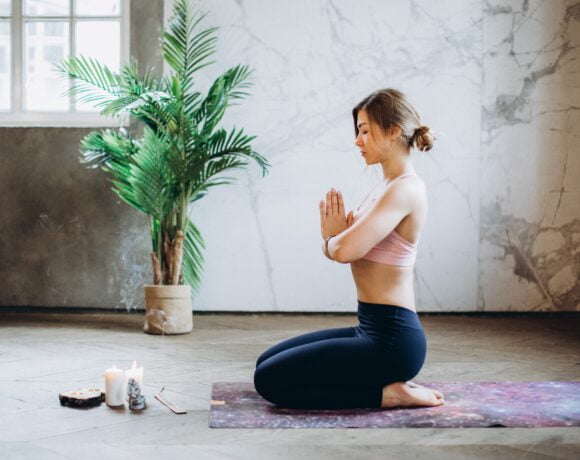
Photo by cottonbro from Pexels

STEP 5. Do not expect results. Expectations carry us into the future and prevent us from concentrating. The purpose of meditation is to bring us to the present moment and help us feel life here and now. 

One cannot be too busy to meditate. An old Zen saying suggests, “You should sit in meditation for twenty minutes every day — unless you’re too busy. Then you should sit for an hour.” Thus, in days when you are unable to find yourself even a couple of minutes to relax, maybe you need meditation more than ever.

Boost Brainpower

Wondering how to release tension after a stressful day and enhance your intelligence simultaneously? Great, because what you do in your free time can significantly affect the level of productivity, creativity and quality of life overall.

Hobbies are not only remedies for stress relief. There are some types of leisure activities that not only bring pleasure but also boost your brainpower.

Explore fresh ideas from the list below, find an appealing hobby and surprise your brain with a new beneficial habit:

1. Meditation

Photo by Felipe Borges from Pexels

Meditation positively affects the human brain and boosts productivity. Studies have shown that meditation bolsters the prefrontal cortex, the area of the brain that regulates our focus and self-discipline. In other words, regular meditation will assist your brain to work efficiently and make thoughtful decisions on a neurological level. This also means you will learn how to control your own emotions and feelings, thus feel more confident and even happier.


2. Sports

Any kind! The smartest people of all ages devoted a significant part of their time to physical exercises. Socrates was a wrestler, Kant could not live a day without walking a dozen miles in Königberg… Besides, relying on Neuroscience magazine’s experiments on monkeys, the ones who did physical exercises regularly mastered new tasks and performed them twice as fast then the other primates.


Thus, sports improve neural connections in the brain, enhance blood flow and promote productiveness on brain functionality. Of course, you do not have to sign for Thai boxing classes tomorrow, but you could always start jogging in the park nearby. It is convenient and free!


3. Gardening

It is a surprisingly effective and useful hobby for the brain. When you grow vegetables, fruits or flowers, you reduce the level of cortisol, the stress hormone, therefore, your attention and focus are improved. The positive emotions from coming to your garden and enjoying the views of nature or contemplating the results of your work also benefit your brain, making you a happier, and, therefore, a more productive and creative person.


4. Knitting

Experts claim knitting is a great way to deal with anxiety, depression and even chronic pain. The benefits of working with hands can be compared to the effect of meditation. Knitting activates the parasympathetic nervous system and dulls the “hit or run” reaction. Thus, it can help restless people to slow down and finish their work in a shorter time.


5. Playing a Musical Instrument

Many studies have proven that playing a musical instrument enhances creativity and memory, brushes up linguistic skills, fine motor skills and much more. No matter what you are playing, a guitar or a violin, the corpus callosum, connecting the hemispheres, creates new neural connections in the brain. An improvement in the state of this organ entails an increase in the level of executive skills, memory, the ability to solve problems and the functioning of the brain as a whole, regardless of how old you are.


6. Reading

No matter what you read, whether it is a romantic novel or an article in The New York Times, the benefits will be the same. Reading lowers stress levels which makes you more focused and relieved. Assistance in solving problems, forming a single core of knowledge for better daily navigation, identifying relationships, understanding processes, empathy – all these qualities boost by systematic reading.


7. Learning New Languages

The ability to speak multiple languages is advantageous not only in career opportunities but in traveling, understanding foreign cultures and discovering new information without wasting time on Google Translator.
Learning a second language may help you ​​boost concentration on a certain task, as well as protect your memory. It preserves the active mechanism by which knowledge contained in your brain is processed.


8. Chess

Photo by Engin Akyurt from Pexels

The research article about Chinese board-game players showed that chess players have a good memory and learn quickly because they have a highly developed neural network. When playing chess, new brain connections are actively formed: the more of them exist, the faster the information is transmitted. Thus, undoubtedly, such activity positively influences the understanding of speech and coordination and so increases the learning speed. Even an amateur chess player will be able to solve problems of different nature much faster.


9. Dancing

Scientists concluded that dancing positively affects brain performance for people of all ages. It improves the connection between neurons of the cerebral cortex and the hippocampus, which is responsible for the transition of short-term memory to long-term, spatial orientation and retention of attention.


10. Video Games

The regular video games playing develops spatial memory, navigation and visual-spatial skills. Such conclusions were made by American scientists in the article “The Impact of Video Games on Cognitive Activity.” They explored action games such as Call of Duty and found that first-person shooters develop the prefrontal cortex, the right hippocampus and the cerebellum.

However, Aaron Seitz, a professor of psychology at the University of California, believes that cognitive abilities develop only if you play no more than an hour a day. So don’t get too carried away!


Isn’t it amazing to be able to boost your intelligence by doing something fun? The above activities, scientifically proven to be beneficial, can always become your effective brain exercise. If you choose to spend your evenings doing something useful rather than binge-watching Netflix, your brain will thank you sooner or later. And who knows, maybe you will not only diversify your routine but also rediscover your individuality.